
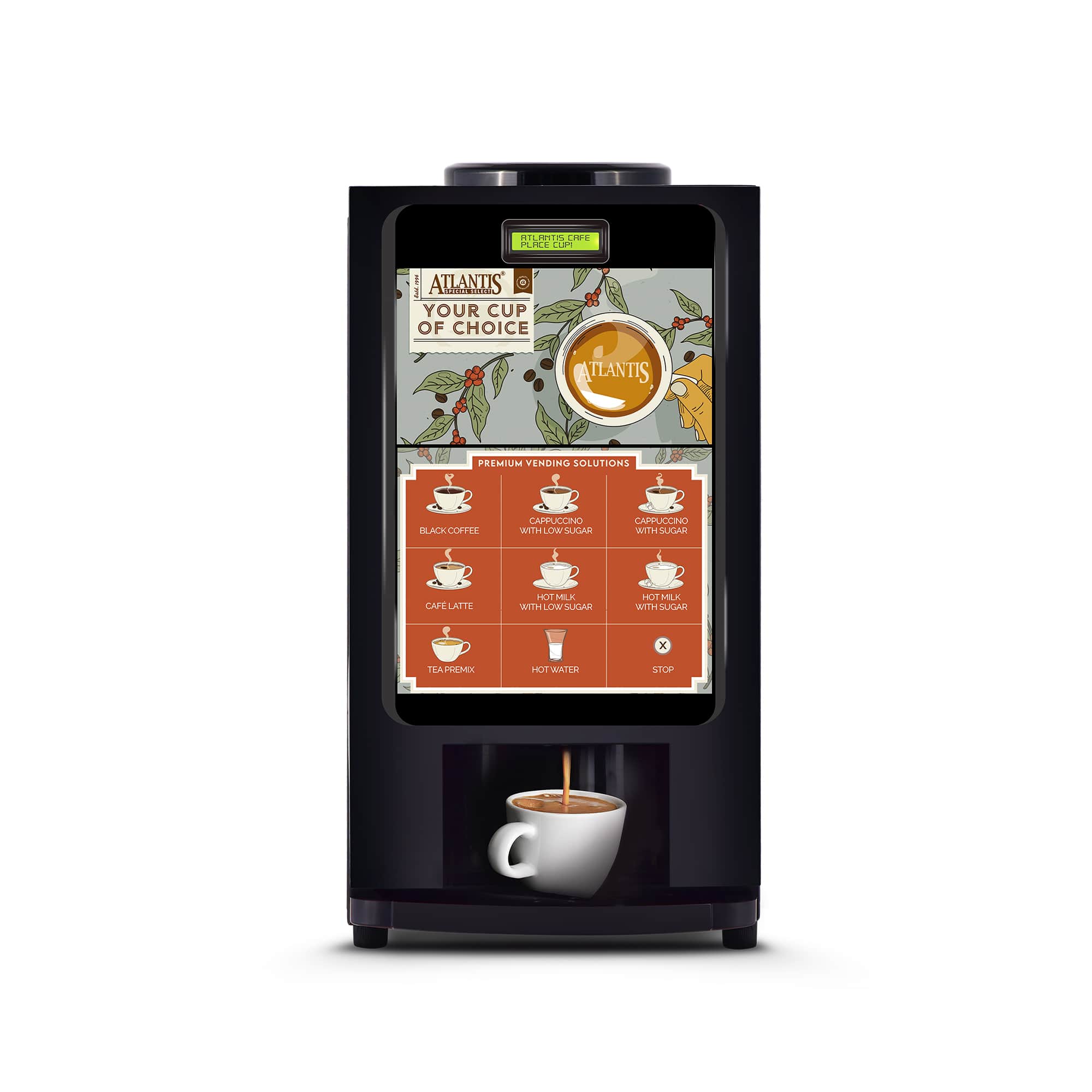
The first question almost every aspiring owner asks is simple: magkano ba talaga ang kita sa coffee vendo? It is a fair question, but the honest answer is that it depends entirely on your location, foot traffic, pricing and costs. What we can do is show you the math transparently, so you can plug in numbers that match your own spot.
The formula behind every coffee vendo income
Before the scenarios, here is the simple structure. Your monthly profit comes down to four things: how many cups you sell, how much you charge, how much each cup costs to make, and your fixed monthly costs like electricity and rent.
- Monthly revenue = cups per day x price per cup x days open
- Ingredient cost = cups per day x premix cost per cup x days open
- Gross profit = revenue minus ingredient cost
- Net profit = gross profit minus fixed costs (power, rent, water, upkeep)
The assumptions we are using
To keep the examples honest and repeatable, here are the fixed assumptions applied across all three scenarios. These are illustrative estimates, not fixed prices you will pay.
| Assumption | Value used (illustrative) |
|---|---|
| Price per cup charged | ₱15 |
| Premix cost per cup | ₱5 |
| Gross margin per cup | ₱10 |
| Days open per month | 30 |
| Electricity (est.) | ₱500 / month |
| Other fixed costs (water, cups, upkeep, rent share) | ₱1,500 / month |
| Total fixed costs | ₱2,000 / month |
A quick note on cost per cup: your real premix cost depends on the drink and pack size. FIFI premix packs run roughly ₱175 to ₱1,800, and you can compare types on our tea and coffee premixes page. We used ₱5 per cup as a mid-range illustrative figure.
Scenario 1: Low volume (30 cups/day)
A quiet spot, maybe a small sari-sari store or a low-traffic corner. Thirty cups a day is modest but realistic for a starter location. Revenue works out to 30 cups x ₱15 x 30 days = ₱13,500 per month. Ingredient cost is 30 x ₱5 x 30 = ₱4,500. After ₱2,000 in fixed costs, that leaves an illustrative net of ₱7,000 per month.
Scenario 2: Medium volume (60 cups/day)
A decent office pantry, a busier store, or a clinic waiting area. Sixty cups a day is a healthy mid-range target once a location is established. Revenue is 60 x ₱15 x 30 = ₱27,000; ingredients are 60 x ₱5 x 30 = ₱9,000; after ₱2,000 fixed costs, the illustrative net is ₱16,000 per month.
Scenario 3: High volume (120 cups/day)
A high-traffic spot: a busy canteen, a school corridor, a factory break area or a transport terminal. One hundred twenty cups a day is strong but achievable in the right location. Revenue is 120 x ₱15 x 30 = ₱54,000; ingredients are 120 x ₱5 x 30 = ₱18,000; after ₱2,000 fixed costs, the illustrative net is ₱34,000 per month. See our guide to the best places to install a coffee vending machine.
Illustrative monthly summary (all figures example only)
| Scenario | Cups/day | Monthly revenue | Ingredient cost | Fixed costs | Net profit (illustrative) |
|---|---|---|---|---|---|
| Low | 30 | ₱13,500 | ₱4,500 | ₱2,000 | ₱7,000 |
| Medium | 60 | ₱27,000 | ₱9,000 | ₱2,000 | ₱16,000 |
| High | 120 | ₱54,000 | ₱18,000 | ₱2,000 | ₱34,000 |
The math for each row: revenue = cups x ₱15 x 30; ingredient cost = cups x ₱5 x 30; net = revenue minus ingredient cost minus ₱2,000 fixed. For example, medium: 60 x 15 x 30 = ₱27,000 revenue; 60 x 5 x 30 = ₱9,000 ingredients; ₱27,000 minus ₱9,000 minus ₱2,000 = ₱16,000 illustrative net.
Break-even: how fast does the machine pay for itself?
Break-even is where these scenarios get motivating. Take the illustrative net profit and divide the machine price by it to estimate how many months to recover your machine cost. Below we use a Classic 2-Lane at ₱22,500 and a Neo 4-Lane at ₱29,600 as examples. Full pricing is in our coffee vending machine price guide.
| Scenario | Net/month (illustrative) | Months to recover ₱22,500 | Months to recover ₱29,600 |
|---|---|---|---|
| Low | ₱7,000 | ~3.2 months | ~4.2 months |
| Medium | ₱16,000 | ~1.4 months | ~1.9 months |
| High | ₱34,000 | ~0.7 months | ~0.9 months |
Even the low scenario recovers a mid-range machine in roughly two to three months on paper. But remember: these ignore slow opening weeks, seasonal dips, spoilage, and the time it takes to build regular customers. Treat them as a ceiling, not a promise. The full startup steps are covered in how to start a coffee vending machine business.
What can quietly eat your profit
- Location miss: a low-traffic spot may never reach 30 cups/day
- Underpricing: shaving ₱3 off each cup can halve your net
- Downtime: an unmaintained machine that stops earns ₱0 that day
- Spoilage and waste: poor storage of premix in humid conditions
- Rent creep: a high stall fee can wipe out a small-volume machine
This is where a low-maintenance premix machine helps. Fewer breakdowns means fewer zero-income days, and a 1-year on-site warranty means repairs do not come out of your pocket in year one.
Want help estimating earnings for your specific location? Book a free demo and we will walk through realistic cup counts and machine options with you.
The honest takeaway
A coffee vendo business can be a solid earner, but the income is driven by location and discipline, not by the machine alone. Use the framework above with your own honest cup-count estimate, keep your pricing sensible, and maintain the machine so it never sits idle. If the numbers work for your spot, explore machines on our vending machines page or contact us to talk options like rent-to-own.